

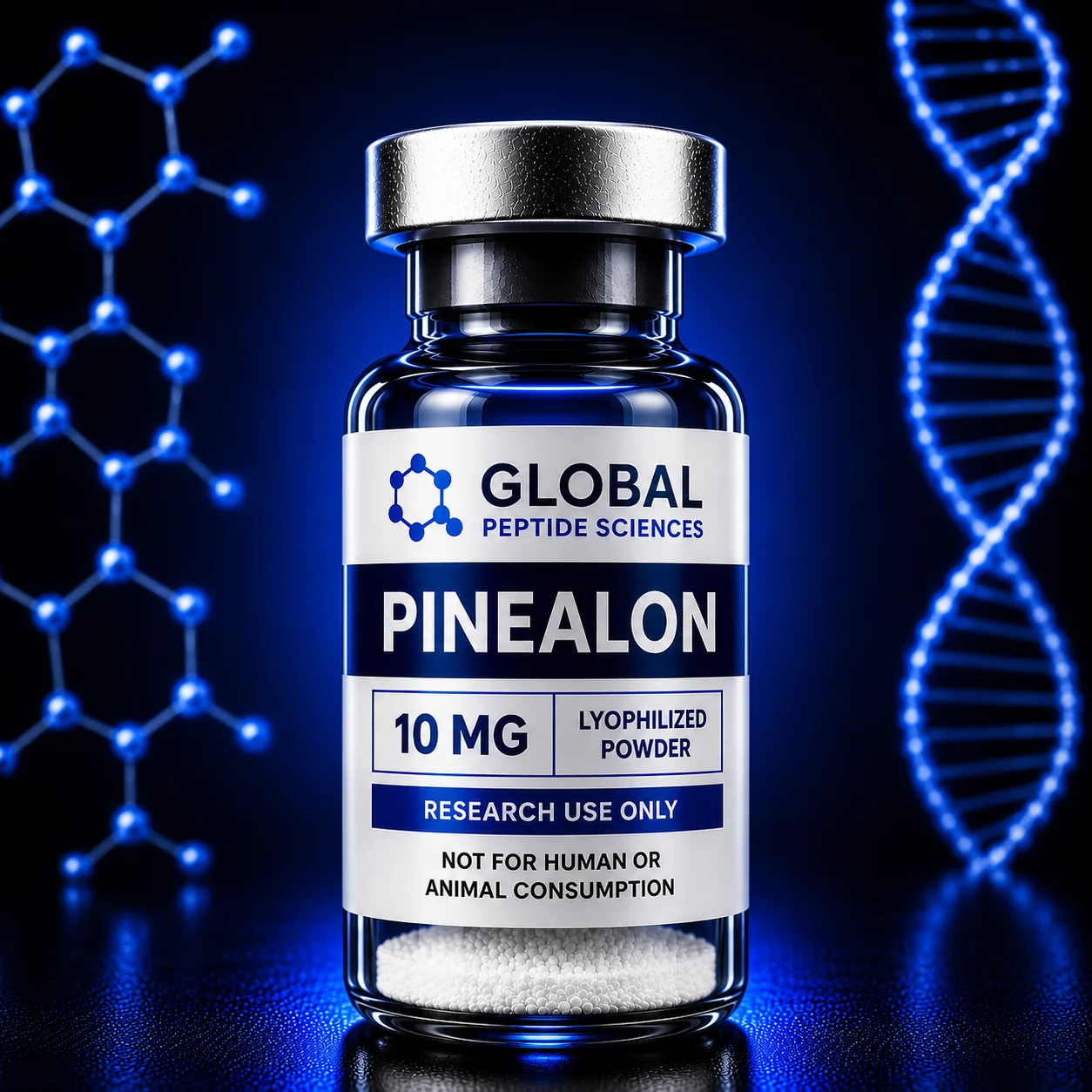
What is Pinealon
Global Peptide Sciences supplies pinealon to laboratories across Australia, supporting studies into neuronal oxidative stress, gene expression and cognitive-ageing models.
Pinealon, also known as EDR or Glu-Asp-Arg, is a synthetic tripeptide developed by Vladimir Khavinson’s group in St Petersburg. The sequence is also found in Cortexin, a bovine brain-derived polypeptide preparation. Most published work comes from cell cultures and animal models, much of it from the developing group, and independent human data are scarce.
Each batch is produced under controlled manufacturing conditions and undergoes independent laboratory verification, supporting consistent, repeatable results across analytical testing. A Certificate of Analysis is available on request for every order.
What Is Pinealon Peptide?
Many researchers ask what is pinealon peptide and what is pinealon peptide used for in laboratory settings, given how often short tripeptides appear in neuroscience literature.
Pinealon belongs to a group of ultrashort pinealon peptides and related tripeptides described as peptide bioregulators. In research models it is studied for its effects on reactive oxygen species, MAP kinase signalling and neuronal gene expression. In rat cerebellar granule cells it restricted reactive oxygen species accumulation in a dose-dependent way and altered the timing of ERK1/2 activation, and similar work has examined hypoxia and ageing models.
Pinealon Benefits Explored in Research
Within controlled laboratory settings, research connected to pinealon benefits commonly looks at areas such as:
- Neuroprotection against oxidative stress in cultured neurons
- Reactive oxygen species and antioxidant enzyme pathways
- MAP kinase and apoptosis signalling in neuronal models
- Hypoxia and cerebral stress models
- Neuronal gene expression and protein synthesis
- Age-related cognitive decline models
These points reflect laboratory observation only and are not intended as claims about therapeutic outcomes. Most findings come from in-vitro and animal studies and should not be read as established effects in people.
Research Areas of Interest
- Studies into neuronal oxidative stress and hypoxia
- Investigation of MAP kinase and apoptosis signalling
- Comparative research on short-peptide gene expression effects
- Brain ageing and neurodegeneration models
Product Information
- Compound: Pinealon (EDR)
- Classification: Synthetic neuroactive tripeptide
- Sequence: Glu-Asp-Arg
- Length: 3 amino acids
- Molecular formula: C15H26N6O8 (approximately 418.4 g/mol)
- Form: Lyophilised powder (white)
- Purity level: 98% or above (HPLC verified)
- Testing: Independent third-party laboratory verification, CoA available on request
- Storage: Store dry at -20°C for long-term storage
Pinealon Reconstitution
Researchers reconstituting pinealon for laboratory use typically follow standard laboratory protocols for combining lyophilised peptides with an appropriate sterile diluent prior to further analytical handling. Global Peptide Sciences does not provide reconstitution instructions intended for self-administration, and all reconstitution should be carried out in accordance with your own laboratory’s established procedures and safety documentation.
Why Researchers Study Pinealon
Laboratories examining neuronal stress responses reference pinealon for its small, defined sequence and for a literature spanning cell culture, hypoxia and ageing models. That literature has limits: it is concentrated in one research network, and independent replication and controlled human studies remain limited.
Searches for pinealon peptide for sleep are common, probably because of the name’s link to the pineal gland. Published work on pinealon centres on neuronal and oxidative stress models, and sleep has not been established as a research endpoint for it, so researchers should treat sleep-related claims as unsupported until compound-specific evidence exists.
Researchers comparing related neuroscience research compounds can explore the cognitive and nootropic research category or the sleep and relaxation research category.
Buy Pinealon in Australia
Researchers looking to buy pinealon peptide can access verified, batch-tested material through Global Peptide Sciences, with independent Certificates of Analysis available for every order.
Laboratories searching for pinealon in Australia can rely on a consistent supply chain backed by HPLC or LC-MS verification as reported by the testing laboratory. Researchers can review the batch report first, checking that it names the compound and sequence, batch number and method, and keeping purity data separate from identity data.
Global Peptide Sciences offers consistent quality control at every stage of supply, and researchers can browse the full catalogue to view other research compounds available alongside pinealon.
Research Use Only
This compound is supplied strictly for laboratory research use and is not approved for human or animal consumption.
Research Applications
Research Applications
Pinealon is used as a research compound to study:
Cognitive function and memory enhancement models
Neuroprotection against oxidative stress
Neuronal gene expression and protein synthesis
Brain aging and neurodegenerative conditions
Cellular metabolism and mitochondrial function
Previous Research Dosages Used
Typical research dosage range: 100–300mcg per day
Common study duration: 10–30 days
These dosage references are based on experimental and preclinical research contexts.
Certificate of Analysis
Chemical Structure
Molecular FormulaC₁₄H₂₄N₆O₇
Molecular Weight~388.4 g/mol
Purity≥99%
AppearanceWhite Lyophilized Powder
StorageStore at -20°C
FormLyophilized Peptide Compound
Key Structural Characteristics
- Short synthetic neuropeptide (tripeptide)
- Interacts with neuronal genetic expression pathways
- Supports redox balance and cellular metabolism
- Widely studied in cognitive and neuroprotection research